
- Free Delivery On Orders Over £100
- Secure Online Payments
-
 Rated Excellent
- Same Day Despatch
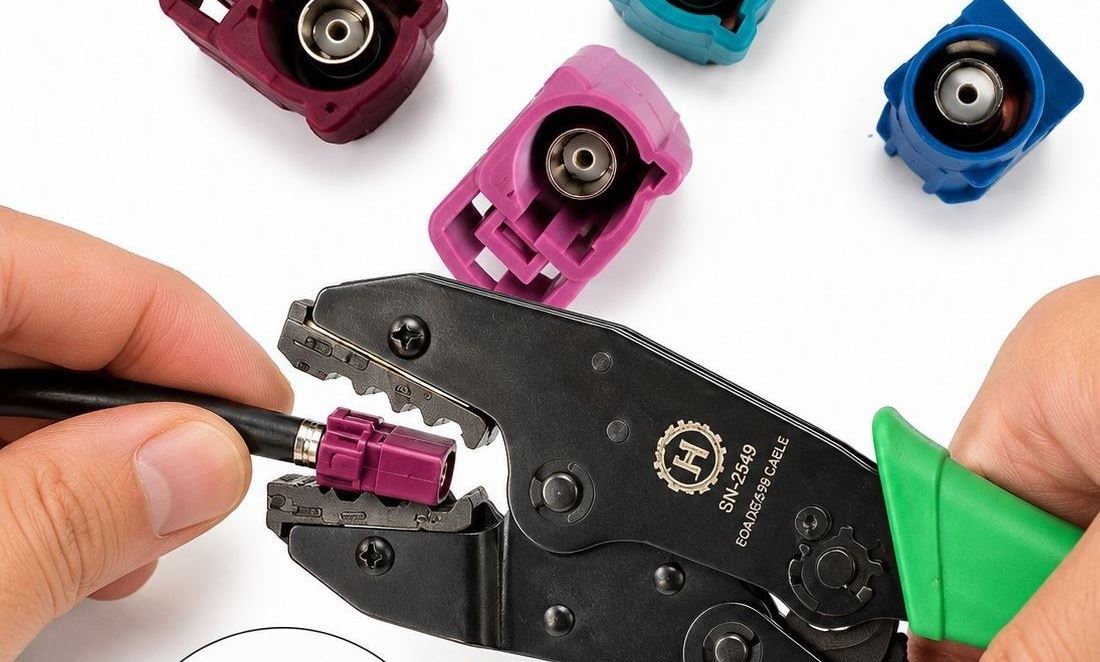
Choosing and crimping the correct FAKRA connector
22 Jul 2026
FAKRA RF Connectors – Colour‑Coded Automotive‑Grade RF Interfaces
FAKRA connectors are high‑performance automotive RF interfaces designed to deliver secure, reliable signal transmission in demanding vehicle environments. Built around a robust SMB coaxial core and enclosed in a colour‑coded, mechanically keyed housing, FAKRA connectors ensure correct mating, prevent mis‑connection, and simplify installation across a wide range of RF systems.
Each connector uses a distinct colour and key code to identify its intended application—such as GPS, cellular, AM/FM radio, satellite radio, cameras, and telematics—making them an industry standard for modern automotive electronics.
Universal Water‑Blue FAKRA Code Z
The Water‑Blue FAKRA Code Z connector is the universal variant within the FAKRA family. Engineered with a neutral keying profile, Code Z is compatible with all FAKRA codes, offering maximum flexibility for manufacturers, integrators, and aftermarket installers.
Ideal for multi‑purpose RF modules, prototyping, and systems requiring a single connector type across multiple interfaces, Code Z maintains full automotive‑grade performance while reducing inventory complexity.
Key Features
-
Universal Compatibility – Water‑Blue Code Z mates with every FAKRA key code for broad application use.
-
Automotive‑Grade Construction – Meets USCAR standards for vibration, temperature, and durability.
-
Secure Locking System – Primary and secondary locking mechanisms ensure stable, long‑term connections.
-
High RF Performance – 50 Ω impedance with excellent VSWR characteristics up to 6 GHz.
-
Colour‑Coded Housing – Provides clear visual identification and prevents incorrect mating.
-
Wide Application Range – Suitable for GPS, cellular, Wi‑Fi, Bluetooth, DSRC, cameras, sensors, and general RF links.
Technical Specifications
-
Impedance: 50 Ω
-
Frequency Range: DC–6 GHz
-
VSWR: < 1.3 (0–3 GHz), < 1.5 (3–6 GHz)
-
Dielectric Withstand Voltage: 800 VRMS
-
Insulation Resistance: ≥ 100 MΩ
-
Mating Cycles: ≥ 25
-
Insertion Force: ≤ 25 N
-
Withdrawal Force: ≥ 2 N
-
Locking Strength: ≥ 80 N
-
Operating Temperature: –40 °C to +105 °C
Applications
-
Vehicle telematics
-
GPS and GNSS receivers
-
Cellular and LTE/5G modules
-
Wi‑Fi and Bluetooth systems
-
Camera and sensor interfaces
-
DSRC and V2X communication
-
General RF connectivity in automotive and industrial systems
How to Crimp FAKRA Connectors
Crimping FAKRA connectors requires the correct tools, proper cable preparation, and attention to detail to ensure reliable RF performance. FAKRA housings use an SMB‑style coaxial interface, so the crimping process is similar to standard RF connectors but with additional steps for the keyed plastic housing.
Tools Required
-
FAKRA connector set (pin, ferrule, and housing)
Step‑by‑Step Crimping Instructions
1. Prepare the Cable
Strip the coax cable according to the connector specification:
-
Outer jacket: remove approx. 6–7 mm
-
Shield/braid: expose approx. 3–4 mm
-
Dielectric: expose approx. 2–3 mm of the centre conductor
The exact dimensions vary slightly by cable type (RG‑174, RG‑316, 1.5DS, etc.), but the goal is:
-
Centre conductor clean and straight
-
Braid folded back evenly over the jacket
-
Dielectric undamaged
2. Crimp the Centre Pin
Slide the centre pin onto the conductor.
-
Ensure the conductor is fully seated inside the pin
-
Crimp using the centre‑pin die on your tool
-
Check that the pin is secure and cannot be pulled off
A good crimp will have:
-
No cracking
-
No deformation
-
Pin aligned straight
3. Fit the Ferrule
Slide the ferrule over the cable before inserting the pin into the connector body. Many installers forget this step—once the pin is inserted, you cannot add the ferrule.
4. Insert the Pin Into the Connector Body
Push the crimped centre pin into the metal SMB body until it clicks into place. You should feel a positive lock. If the pin does not latch, the cable may be stripped incorrectly or the pin may be misaligned.
5. Crimp the Ferrule
Slide the ferrule forward over the braid and connector body. Crimp using the outer ferrule die. The ferrule should compress evenly around the braid without crushing the dielectric.
6. Install the FAKRA Housing
Once the metal body is crimped, snap it into the colour‑coded FAKRA plastic housing. The housing provides:
-
Mechanical keying
-
Primary and secondary locking
-
Correct orientation for the application
For Code Z (Water‑Blue), the housing is universal and mates with all FAKRA key codes.
Quality Checks
After crimping, verify:
-
The pin is fully seated
-
The ferrule is evenly crimped
-
The housing locks securely
-
No exposed braid or damaged dielectric
-
Cable pull strength meets spec (typically ≥ 80 N with housing lock)
Common Mistakes to Avoid
-
Forgetting to slide the ferrule on before crimping the pin
-
Over‑stripping the dielectric
-
Crushing the dielectric during ferrule crimp
-
Using incorrect die sizes
-
Not fully seating the pin in the SMB body